Students,
Welcome to Western!
This semester in Chem 191 we’ll be studying atmospheric chemistry. We’ll learn the chemistry behind air quality, discuss how our actions affect the atmosphere at local, regional, and global levels, and talk about what effects those actions might have on humans around the world. Throughout the semester, we’ll focus our thoughts on one question: Is clean air a right?
I’d encourage you to continually consider and reconsider this question as we move through the course material. We’ll explore it from many angles as we participate in lectures, readings, discussions, and a semester-long project to build and deploy Arduino-based air quality sensors.
The first part of the semester will be focused on laying the necessary foundations. We’ll work to understand the basics of chemistry and the scientific method, and then apply those concepts to the atmosphere. In parallel, we’ll be working on constructing air quality sensors in preparation for a field trip to Great Smoky Mountain National Park in mid-October. After that, we’ll work to apply our foundational knowledge toward understanding issues of pollution and air quality. Finally, after allowing the sensors to collect data for several weeks in the Smokies, we’ll process the data and see what we can learn from it.
Please pick up copies of the rental textbook, Air Pollution and Global Warming by Mark Z. Jacobson, and the supplemental book, The Atmosphere: A very short introduction by Paul I. Palmer, from the WCU bookstore as soon as possible. You will also need to access Chemistry: Atoms First on the OpenSTAX website and other online materials throughout the semester. These will be linked through the class website: alphonse.github.io/archive/chem191-f2019.
Speaking of the website, it will be the hub for all the course materials. It contains the syllabus, schedule, homework assignments, and supplemental resources. Please spend some time familiarizing yourself with the materials there.
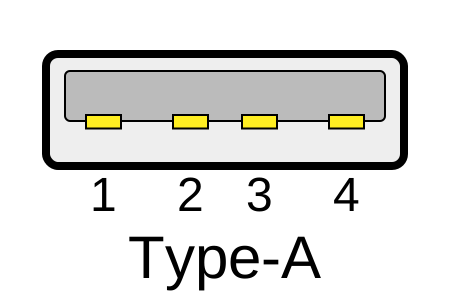
In addition to the textbook, you’ll need a laptop computer with a standard USB port (USB-A port, looks like this and connects to this). If you have a newer computer without a traditional USB port (a Macbook, for example), you’ll need to pick up a USB C (male) to USB A (female) adapter and bring it and your laptop with to class on Wednesday of the second week.
Finally, I’d encourage you all to read this year’s One Book, We Need to Talk: How to have conversations that matter by Celeste Hadley. This book lays the groundwork necessary for thoughtful, productive conversations, and will aid our class discussions.
Our first class is Monday, August 19 at 3:35 PM. I look forward to meeting you all then.
-Dr. Fischer